|
UV GUIDE
UK
Advances
in Reptile Lighting
A
resource for all reptile keepers
|
|
What
is photo-kerato-conjunctivitis?
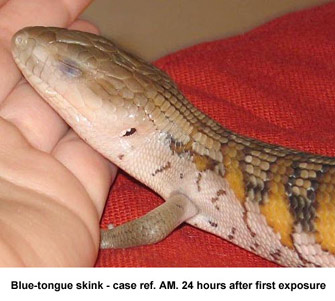 This
is a painful eye condition caused by excessive exposure
to UV radiation. This
is a painful eye condition caused by excessive exposure
to UV radiation.
It
is exactly the same as "snow blindness" in skiers,
from excessive UV reflected from snow, and "arc welder's
flash" experienced by people working with metal welding
equipment, who have not worn protective glasses. It is very
painful - like having sand in your eyes - and it is caused
by damage to the delicate transparent cells on the surface
of the eye (the cornea) and the lining of the eyelids. Fortunately,
only the superficial layers of the eye are affected; the
lens and retina are not damaged (the UVB does not reach
the deep structures of the eye) and so it does not cause
permanent blindness.
The
pain is protective (it makes sufferers close their eyes)
and healing begins at once, when the harmful UV light is
removed. Unless there have been serious burns, the eyes
heal remarkably quickly. The damaged cells are replaced
within days and the pain disappears.
Most
cases open their eyes again within 2 - 3 days and all symptoms
are gone within a week or so, with no medication being necessary.
If there has been skin damage to the eyelids this may take
a little longer and veterinary examination is essential
in case the damaged skin has become infected. We have heard
reports of some cases with a sticky discharge from the eye
and/or peeling of the skin around the eyelids.
|
"Help!
I think my reptile has this problem, what shall I do?"
Please
don't panic. Please check out the following points:
1.
Is your reptile ill? (Inactive, not basking, not feeding?)
If
your reptile is ill, the first thing you must do
is seek specialist veterinary advice. There are many
causes of illness in reptiles which have nothing to
do with exposure to UVB light....A sick reptile urgently
needs to be examined by a veterinary surgeon experienced
with reptiles.
2.
Does your reptile refuse to open its eyes, or have swollen
eyelids? (Symptoms of photo-kerato-conjunctivitis)
Please
understand that there are many other causes of eye problems
in reptiles. Turtles and tortoises are particularly susceptible.
Similar symptoms can occur with eye infections, certain
vitamin deficiencies and even dust or sand in the eyes.
Your reptile should be examined by a reptile specialist
vet to rule out other causes - which may need specific treatments
such as antibiotics. If you are concerned that the lamp
may have contributed to the problem, print out some of the
information from this page to show your veterinarian.
However,
if your reptile is showing these symptoms AND
you
have recently installed one of the lamps featured in this
report - especially if your reptile can get close to the
lamp -
yes, it is possible that your pet has developed photo-kerato-conjunctivitis.
-
It will do no harm, in the short term, to switch
off the new UVB lamp for 1 - 2 days. (The sun
does not shine every day, even in the tropics.) Do
not switch off the (non UVB) basking light or heating!
If the UVB lamp was the source of the problem, recovery
may be seen (but do not wait 1-2 days before seeking
veterinary help, if your reptile is ill.)
- Double
check the distance of your lamp from the reptile.
Check out the manufacturer's instructions regarding minimum
basking distances and also read our reports carefully,
to see whether at the distance your lamp was set, the
UV radiation could have been excessive. If you plan on
continuing to use the lamp, ensure that when you use it
again, it is placed at a suitable distance.
- Were
you using an aluminium reflector? This can boost the UVB
beneath a lamp to extremely high levels. Check the details
in our report.
- Was
your reptile able to move into a sheltered area away from
the UV lamp? It is essential that every set-up provides
areas of shade; a UVB gradient is as essential as a heat
gradient.
- If
your reptile has stopped eating and drinking, there may
be a risk from dehydration, particularly with young hatchlings.
Seek veterinary advice about offering small drinks of
water (usually by dropper; never force fluids into the
mouth as there is a risk of getting water into the lungs)
- Once
a reptile has completely recovered from photo-kerato-conjunctivitis,
UVB lighting should be provided again, this time at more
suitable levels. Some owners may wish to re-introduce
the lamp which caused the problems, but at a more appropriate
distance. Others may wish to replace the lamp with one
which does not contain the "phototherapy" phosphor
described in our reports.
It might
seem appropriate to re-introduce UVB gradually. We suggest
that initially, the appropriate level of UVB could be offered
for a shorter period of time than normal, building up to
the "full day" over a period of a week or so.
Obviously, we would recommend that you observe your reptile
very carefully for any further problems.
|
|
"How
should I respond to this report?"
(Revised
- September 2009)
1.
When reports of photo-kerato-conjunctivitis first started
appearing, back in 2007, very few people knew what the problem
was, and we encouraged reptile keepers to pass on the information
to their veterinarians, their reptile clubs and groups,
and internet forums.
The condition
is still not widely recognised. Because the most well-known
companies selling the "problem" lamps responded
promptly (either withdrawing lamps from sale or increasing
recommended basking distances and pre-burning the lamps
in the factory, to reduce their output) the number of reported
cases fell rapidly throughout 2008, and we're glad to say,
cases are now rare.
Manufacturers worldwide are becoming aware of the problem
with "non-terrestrial", abnormally short-wavelength
UVB and responsible companies are ensuring that their lamps
do not emit such radiation. This
is excellent news, but it is still
important that reptile keepers and their veterinarians are
aware of the symptoms and remain watchful - particularly
when new products are being introduced to a collection.
Please don't hesitate to share what you've learned about
this subject.
2.
If your own reptiles have developed photo-kerato-conjunctivitis,
and you have reason to believe that this was due to your
use of any UV lamp currently sold for reptiles, you
may wish to write a case history. If so, we suggest that
you send one copy to us, and one to the contact address
for the company who manufactured your lamp. (This can usually
be found on the company's website.) Please include your
name and address in your report, although we will keep this
completely confidential. We also
suggest you inform your veterinary surgeon, and the store
where you purchased the lamp. We believe that
this is important, as it will help prevent further cases.
Many veterinary surgeons will not have seen a reptile with
photo-kerato-conjunctivitis before, and will be interested
to hear of the report. Pet stores may also be glad to know
about it.
3.
You are welcome to give a link to us - http://www.uvguide.co.uk
- but please do NOT copy and
paste anything from this report. This could easily
be misleading, taken out of context. It's also unfair on
the people who have kindly offered their distressing pictures
of much-loved pets. These belong only in this report.
We
have not tested every lamp of every brand in the world -
nor can we hope to, nor should we have to! We
are not in the pet reptile lighting industry! We hope our
findings are helpful, however. We are endeavouring to test
new lamps from major companies but we still have a number
of new products awaiting testing. If you buy a new lamp,
read all the accompanying data carefully. Always follow
the manufacturers' instructions and double check your distances,
temperatures at the basking spot, and provision of shade.
And above all... observe your reptile and his response to
the lamp.
|
|
© 2009 UVGuide.co.uk
|


